Common verbs which take the dative case:
antworten - to answer
danken - to thank
fehlen - to be missing
folgen - to follow
gehören - to belong to
gefallen - to please/make happy
glauben - to believe
helfen - to help
Leid tun - to be sorry
passieren - to happen
verzeihen - to forgive
weh tun - to hurt
befehlen - to order
begegnen - to encounter
bleiben - to stay
dienen - to serve
drohen - to threaten
einfallen - to occur to, think of
erlauben - to allow
gehorchen - to obey
gelingen - to succeed
misslingen - to fail
geraten - to turn out well
geschehen - to happen
gratulieren - to congratulate
nützen - to be of use
passen - to fit, suit
raten - to advise
schaden - to harm
schmecken - to taste
ver/trauen - to trust
widersprechen - to contradict/disagree with
+ separable verbs taking a 'zu' prefix, e.g. zuhören, zustimmen
Monday, 24 March 2014

Saturday, 22 March 2014
Intercultural Learning - Academic Role Play
Discussing a problem with a lecturer:
- Greet the lecturer: Guten Tag, Dr/Professor X - make sure to use their proper title and name
- Introduce yourself: Mein Name ist/Ich heiße Y und ich bin Erasmusstudent/in
- Tell them which Kurs you're in - Ich nehme an Ihrem Kurs "Z" teil (teilnehmen an + dat - to take part in, attend)
- Explain your problem - Ich möchte . . . mit Ihnen besprechen - I would like to discuss . . . with you (at this point the lecturer might say something like "Das können Sie natürlich machen" - of course you can)
- Possible problems - nicht auf die Liste setzen - to not be the list/schlechtes Resultat, Note in einer Hausarbeit bekommen (getting a poor result in an essay)/Thema einer Hausarbeit besprechen - discuss the topic of an essay
- Lecturer's answer to question - explaining the poor result, making suggestions to do with topic etc
- To lengthen it, create conflict - don't solve problem immediately - the course could be full - es gibt kein mehr Plätze frei/ the result won't be improved - explain why the essay was bad - nur eine Quelle benutzt - only one source used, zu kurz - too short - Argumente sollten weiter entwickelt sein - arguments should be further developed/ Sie sollten sein Thema verändern - you should change your topic, ein anderen Blickwinkel finden - find a different angle, POV, Sie sollten mehr Forschung machen - you should do more research
- Resolve problem - gibt es ein ähnlichen Kurs zu dem ich mich anmelden könnte - is there a similar course I could sign up for, gibt es eine Warteliste - is there a waiting list, könnten Sie meinem Name dazu hinzufügen - could you add my name to it?/Danke für Ihren Rat/Ihre Vorschläge - thank you for your advice/suggestions/ Ich werde mehr Forschung machen - I will do more research
- Thank them - Danke schön für Ihre Zeit - thank you for your time
- Say goodbye - Auf Wiedersehen (Don't use Tschüss, too informal)
Formal Email to German Lecturer Template
Greeting: Sehr geehrte Frau Professor X/Sehr geehrter Herr Professor X
Content - As formal as possible - Use Sie, Ihnen. Say bitte and Danke with questions. Also Subjunctive II - e.g. Könnten Sie mir bitte x erklären? - Could you please explain x to me?
Ich möchte wissen ob . . . - I would like to know whether
Sollte ich x machen - Should I do x?
Keep it short, lecturers might not read a long email.
Ending: Mit freundlichen Grüßen, Beste/Schöne Grüße (No punctuation after!)
Name
(Don't end with just Grüße or any acronyms like MfG, LG etc)
Content - As formal as possible - Use Sie, Ihnen. Say bitte and Danke with questions. Also Subjunctive II - e.g. Könnten Sie mir bitte x erklären? - Could you please explain x to me?
Ich möchte wissen ob . . . - I would like to know whether
Sollte ich x machen - Should I do x?
Keep it short, lecturers might not read a long email.
Ending: Mit freundlichen Grüßen, Beste/Schöne Grüße (No punctuation after!)
Name
(Don't end with just Grüße or any acronyms like MfG, LG etc)
Wednesday, 2 October 2013
FR2602 - Post-Impressionism, Cubism and Futurism
The French painter Paul Cézanne acted as a bridge between impressionism and other, stranger movements that occurred in modern art at the beginning of the 20th century, like cubism and futurism. Cézanne is famous for his attention to forms and shapes, which he treated as being more important than actual painting content. The subject of the painting became a series of shapes that became more and more abstract. Cézanne wanted people to view the world as in colours and geometric figures and he expressed this personal world view through his painting. Cézanne is a major figure in modernism because he was an important stepping stone in art's path to abstraction. Abstraction does not mean vagueness but rather taking the world and imposing your own view on it, instead of just documenting real life as painting did before photography.
Cézanne often painted the same subject multiple times, especially still lives of apples and landscapes.

He did this because he wanted to experiment with form. The subject was not important to him. He was attempting to capture the range of colours and possibities available from every day objects. He used the colours as a type of perspective, the strength of the colour reflecting the depth.
Cézanne also painted the landscape (Mt. Saint-Victoire) hundreds of times over 20 years.


Each time he painted it, it was different. This is not just because of the change that time inflicted on the landscape but also because of the changes in the artist himself. The more he painted it, the more abstract it became, until it properly reflected his world view. Cézanne was also unafraid to include references to industry, i.e. the railway bridge. In fact, many impressionists were fascinated by the idea of industry and progress and trains, stations and railway bridges often featured in their paintings. The station was viewed as a gateway to the modern world while the bridge was a sign of progress and was often painted in use or at a dynamic angle to convey movement.
Cézanne rethought painting: he painted the same thing over and over again to show multiple possible perspectives. This idea is further developed in cubism where they try to show all these perspectives and dimensions at the same time. In some ways, this is inspired by film, as the concept of capturing a moving image is reflected in their paintings. They attempt to show all these possible angles in one painting.

The idea of movement in painting was carried even further in the idea of futurism, a style of painting inspired by film which attempted to capture a sequence of perspectives. They were very focused on 'dynamism' and the idea of the world in continual movement. They also reinvented poetry as they began to question why words should have to go in straight lines and be ordered. One of their chief subjects was war, as they liked to focus on the speed and action.

The leader of the movement was in fact a fascist and supporter of Mussolini. At this point, art began to become more political and the many avant garde movements that developed in the 20th century often had political manifestos and aims.
Cézanne often painted the same subject multiple times, especially still lives of apples and landscapes.

He did this because he wanted to experiment with form. The subject was not important to him. He was attempting to capture the range of colours and possibities available from every day objects. He used the colours as a type of perspective, the strength of the colour reflecting the depth.
Cézanne also painted the landscape (Mt. Saint-Victoire) hundreds of times over 20 years.
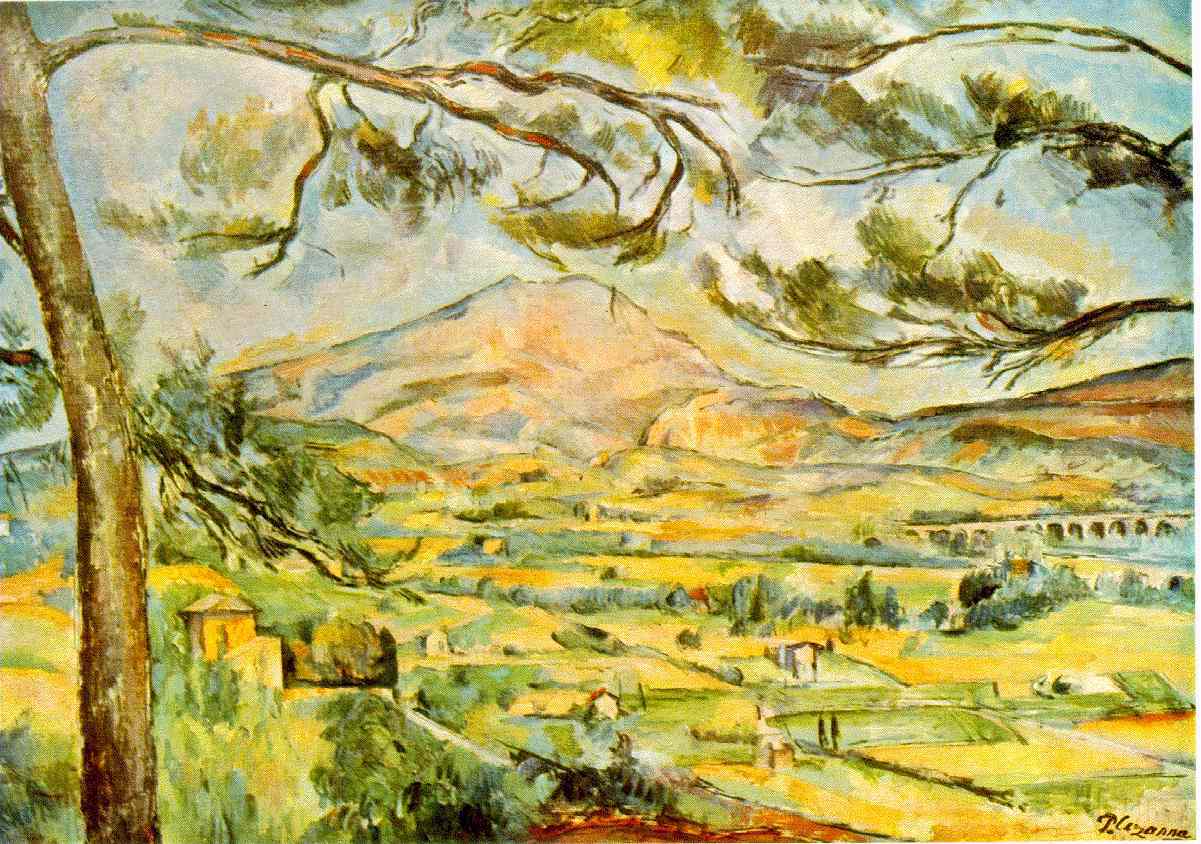

Each time he painted it, it was different. This is not just because of the change that time inflicted on the landscape but also because of the changes in the artist himself. The more he painted it, the more abstract it became, until it properly reflected his world view. Cézanne was also unafraid to include references to industry, i.e. the railway bridge. In fact, many impressionists were fascinated by the idea of industry and progress and trains, stations and railway bridges often featured in their paintings. The station was viewed as a gateway to the modern world while the bridge was a sign of progress and was often painted in use or at a dynamic angle to convey movement.
Cézanne rethought painting: he painted the same thing over and over again to show multiple possible perspectives. This idea is further developed in cubism where they try to show all these perspectives and dimensions at the same time. In some ways, this is inspired by film, as the concept of capturing a moving image is reflected in their paintings. They attempt to show all these possible angles in one painting.
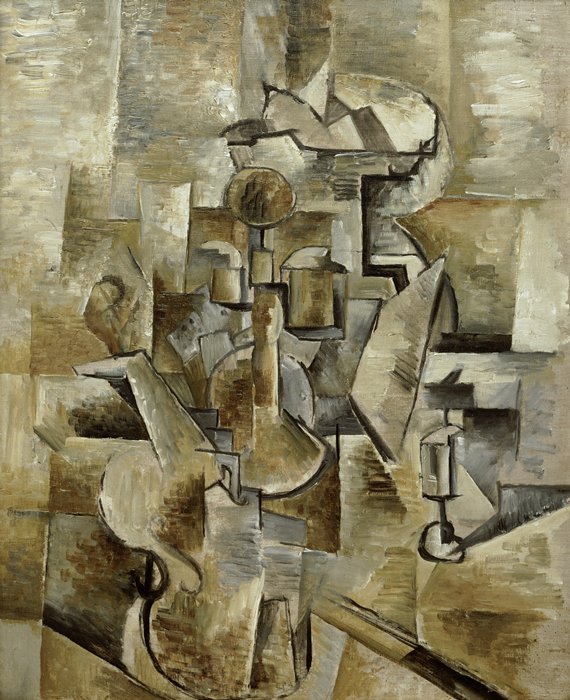
The idea of movement in painting was carried even further in the idea of futurism, a style of painting inspired by film which attempted to capture a sequence of perspectives. They were very focused on 'dynamism' and the idea of the world in continual movement. They also reinvented poetry as they began to question why words should have to go in straight lines and be ordered. One of their chief subjects was war, as they liked to focus on the speed and action.

The leader of the movement was in fact a fascist and supporter of Mussolini. At this point, art began to become more political and the many avant garde movements that developed in the 20th century often had political manifestos and aims.
GE2101 - Grammar - Verbs
Types of verbs:
Intransitive verb - does not take a direct object
*some verbs of motion can become transitive when they take a direct object. E.g. - 'Ich reite' is intransitive but 'ich reite das Pferd' is transitive. 'Das Pferd' has become the object.
The present participle, i.e. the 'ing' form does not exist in German. Instead, the present and an adverb/time phrase is used. E.g. 'ich koche gerade das Essen.' - I am making the meal.
- irregular (stark) - deviate from the normal patterns in all iterations
- regular (schwach) - follow the normal pattern in all iterations
- mixed (gemischt) - contain both regular and irregular elements
- most transitive verbs
- no motion or change of state - e.g. sitzen, stehen, arbeiten - or actions that have no definitive beginning or ending
- reflexive verbs
- modal verbs
- intransitive verbs that indicate a state
- intransitive verbs that express motion* e.g. fahren, laufen, gehen, reiten/change of state - e.g. sterben, einschlafen, aufwachen
- sein, werden, bleiben
- verbs that express happening, success, failure - e.g. geschehen, passieren, gelingen (not used for successes of people. 'Ich bin gelungen' does not work!)
Intransitive verb - does not take a direct object
*some verbs of motion can become transitive when they take a direct object. E.g. - 'Ich reite' is intransitive but 'ich reite das Pferd' is transitive. 'Das Pferd' has become the object.
The present participle, i.e. the 'ing' form does not exist in German. Instead, the present and an adverb/time phrase is used. E.g. 'ich koche gerade das Essen.' - I am making the meal.
GE2126 - Immanuel Kant
The idea of freedom was central to the philosophy of Immanuel Kant, (one of the great thinkers of the German enlightenment) specifically the idea of autonomy. This does not refer to political freedom but rather the concept of thinking freely. He believed that we have a duty to attempt to understand by what principles we act and live and to reflect on the mechanisms and conditions of the ways we get to know anything.
In his famous essay, "What is enlightenment?" Kant stated that we live in a kind of self-imposed immaturity, meaning that we do not use our reason without the guidance of others because we lack the resoluteness and courage to think for ourselves. His motto and the motto of the enlightenment was 'Dare to use your own understanding!' One should educate oneself to develop a reasonable judgement and be able to defend the principles of one's actions and beliefs. It was particularly important to him to be able to critically reflect on one's own beliefs and dearly held truths.
He himself wrote three 'critiques', the Critique of Pure Reason, the Critique of Practical Reason and the Critique of Judgement. These can be understood in the terms of three principle questions, respectively:
Kant is also famous for his aesthetic theory, which he divided into two categories, The Sublime and The Beautiful. He thought of them in terms of aesthetic judgement, believing that the aesthetic experience engaged not just our senses but also our critical faculties of judgement. He did not think that beauty was a purely sensual experience but he did not think it was a purely intellectual one either. He claimed that the experience of beauty involved four key 'moments':
In his famous essay, "What is enlightenment?" Kant stated that we live in a kind of self-imposed immaturity, meaning that we do not use our reason without the guidance of others because we lack the resoluteness and courage to think for ourselves. His motto and the motto of the enlightenment was 'Dare to use your own understanding!' One should educate oneself to develop a reasonable judgement and be able to defend the principles of one's actions and beliefs. It was particularly important to him to be able to critically reflect on one's own beliefs and dearly held truths.
He himself wrote three 'critiques', the Critique of Pure Reason, the Critique of Practical Reason and the Critique of Judgement. These can be understood in the terms of three principle questions, respectively:
- What can I know?
- What ought I to do?
- How can I form a proper judgement?
Kant is also famous for his aesthetic theory, which he divided into two categories, The Sublime and The Beautiful. He thought of them in terms of aesthetic judgement, believing that the aesthetic experience engaged not just our senses but also our critical faculties of judgement. He did not think that beauty was a purely sensual experience but he did not think it was a purely intellectual one either. He claimed that the experience of beauty involved four key 'moments':
- Disinterest - one observes the beautiful object without desiring to possess it or know its purpose.
- Purposiveness - although it appears to serve no purpose, the truly beautiful looks like it was designed for a reason, however, we can't identify this reason.
- Expectation of agreement - we expect that others will agree that this is beautiful but we are unable to explain why they should find it beautifu
- Necessity - that the beauty is a tangible quality like size or shape and cannot be denied by anyone because it's clearly a property of the object.
Politics and culture in classical France
In the time of Louis 14th, the royal court underwent a great deal of change. Social spaces were transformed and a new, self-formed elite emerged. This led to a fascination with the links between discourse and being.
Discourse - a way of using language in a given social context.
The centre of court life was the palace at Versailles. Louis used spectacle (pageants and theatre, often linked to classical culture) to consolidate the image of the monarchy. The notion of the shared identity of the court was expressed by literary means.
An alternative social space to the court known as the salon began to emerge. These were meetings hosted by women in their private homes, however, they were, in their own way, just as structured and hierarchical as the court. They gave women a chance to socialise with central figures of the court along with great writers and artists of the era, who often show cased their work at such events. The salons also acted as a bridge between women interacting with writers and women becoming writers.
At this time, the boundary between the oral and the literary was much more permeable. Literature was read aloud at the salons and the books themselves were secondary, being no more than a means to assert a kind of copyright. Literature was actually a means of social exchange and advancement as writing a poem to a person of higher social status might win you their favour.
As many public offices were for sale at this time, the 'elite' of society had a sudden influx of new members, which many of the older class objected to. A kind of cultural insecurity emerged, as people were unsure as to their place in society. Many literary works were written in an attempt to enshrine 'polite' language exactly as it was. An author named Vaugelas wrote a book advising people on the 'dos and don'ts' of polite French, and while it was only intended as a guide, the Academie Francais regularly republished it with revisions that were actively prescriptive, forbidding certain language usage for polite society.
This question of proper language was all focused on the idea of one question: 'how are you to be?' The nobles were constantly trying to define 'polite' behaviour and in many cases they referred to classical culture to aid this search. The author La Bruyère wrote a book that suggested how one ought to behave by showing how not to behave. He began his book with a translation of the ancient Greek plays by Theophraste. He used the stereotypes of Greek plays to describe the types of characters who frequented the court. This led to much speculation as to who these stereotypes were really based on.
Discourse - a way of using language in a given social context.
The centre of court life was the palace at Versailles. Louis used spectacle (pageants and theatre, often linked to classical culture) to consolidate the image of the monarchy. The notion of the shared identity of the court was expressed by literary means.
An alternative social space to the court known as the salon began to emerge. These were meetings hosted by women in their private homes, however, they were, in their own way, just as structured and hierarchical as the court. They gave women a chance to socialise with central figures of the court along with great writers and artists of the era, who often show cased their work at such events. The salons also acted as a bridge between women interacting with writers and women becoming writers.
At this time, the boundary between the oral and the literary was much more permeable. Literature was read aloud at the salons and the books themselves were secondary, being no more than a means to assert a kind of copyright. Literature was actually a means of social exchange and advancement as writing a poem to a person of higher social status might win you their favour.
As many public offices were for sale at this time, the 'elite' of society had a sudden influx of new members, which many of the older class objected to. A kind of cultural insecurity emerged, as people were unsure as to their place in society. Many literary works were written in an attempt to enshrine 'polite' language exactly as it was. An author named Vaugelas wrote a book advising people on the 'dos and don'ts' of polite French, and while it was only intended as a guide, the Academie Francais regularly republished it with revisions that were actively prescriptive, forbidding certain language usage for polite society.
This question of proper language was all focused on the idea of one question: 'how are you to be?' The nobles were constantly trying to define 'polite' behaviour and in many cases they referred to classical culture to aid this search. The author La Bruyère wrote a book that suggested how one ought to behave by showing how not to behave. He began his book with a translation of the ancient Greek plays by Theophraste. He used the stereotypes of Greek plays to describe the types of characters who frequented the court. This led to much speculation as to who these stereotypes were really based on.
Subscribe to:
Posts (Atom)