Wednesday, 2 October 2013

FR2602 - Post-Impressionism, Cubism and Futurism

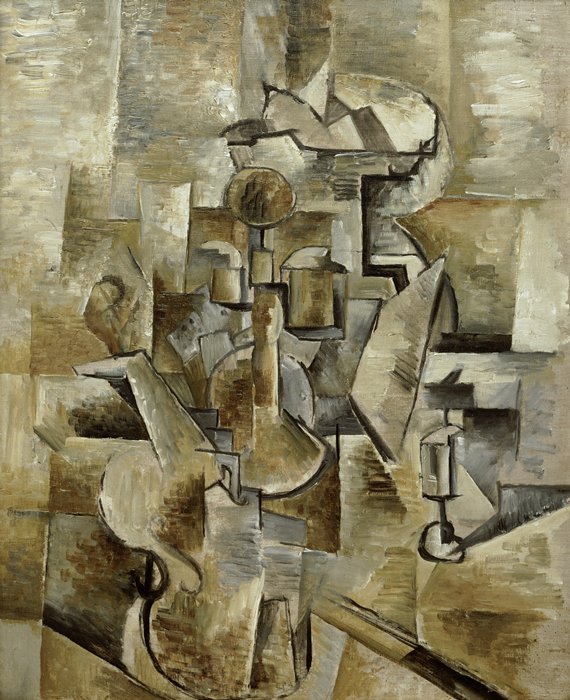
The French painter Paul Cézanne acted as a bridge between impressionism and other, stranger movements that occurred in modern art at the beginning of the 20th century, like cubism and futurism. Cézanne is famous for his attention to forms and shapes, which he treated as being more important than actual painting content. The subject of the painting became a series of shapes that became more and more abstract. Cézanne wanted people to view the world as in colours and geometric figures and he expressed this personal world view through his painting. Cézanne is a major figure in modernism because he was an important stepping stone in art's path to abstraction. Abstraction does not mean vagueness but rather taking the world and imposing your own view on it, instead of just documenting real life as painting did before photography.

Cézanne often painted the same subject multiple times, especially still lives of apples and landscapes.


He did this because he wanted to experiment with form. The subject was not important to him. He was attempting to capture the range of colours and possibities available from every day objects. He used the colours as a type of perspective, the strength of the colour reflecting the depth.

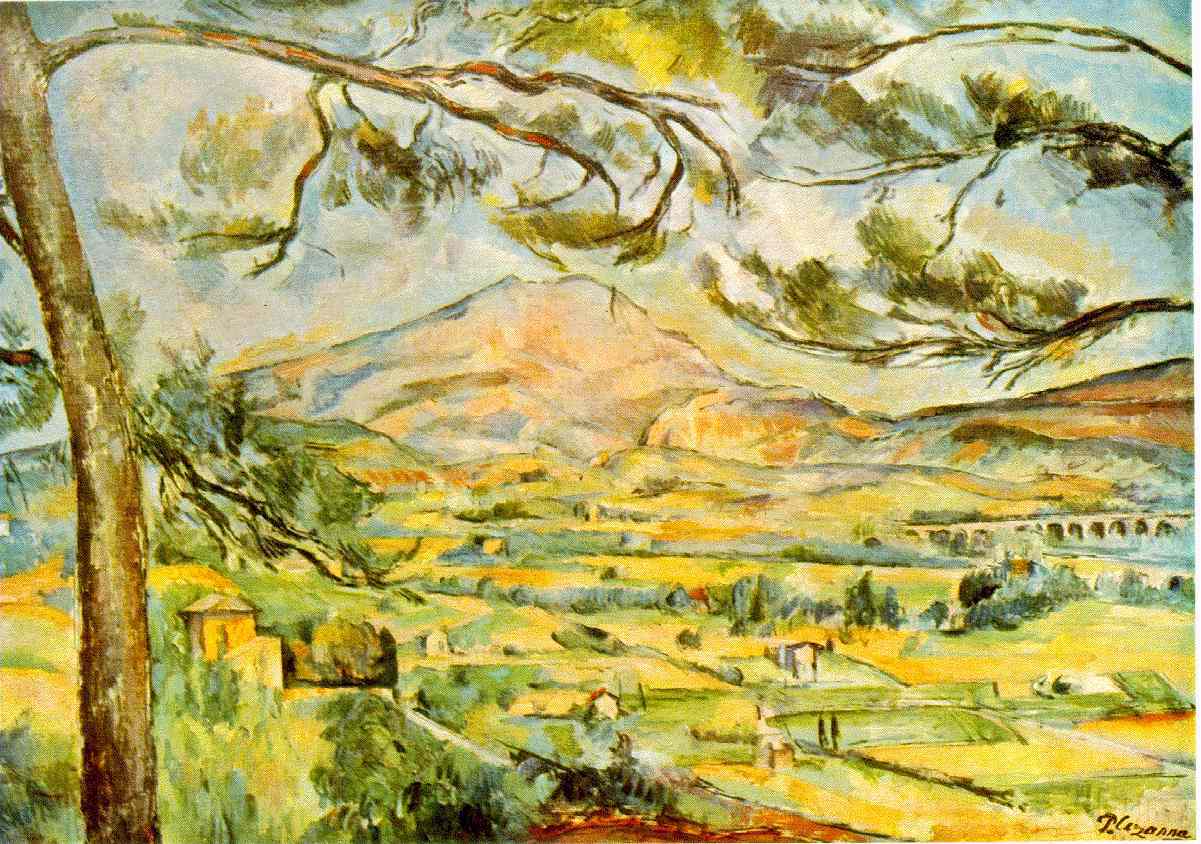
Cézanne also painted the landscape (Mt. Saint-Victoire) hundreds of times over 20 years.


Each time he painted it, it was different. This is not just because of the change that time inflicted on the landscape but also because of the changes in the artist himself. The more he painted it, the more abstract it became, until it properly reflected his world view. Cézanne was also unafraid to include references to industry, i.e. the railway bridge. In fact, many impressionists were fascinated by the idea of industry and progress and trains, stations and railway bridges often featured in their paintings. The station was viewed as a gateway to the modern world while the bridge was a sign of progress and was often painted in use or at a dynamic angle to convey movement.

Cézanne rethought painting: he painted the same thing over and over again to show multiple possible perspectives. This idea is further developed in cubism where they try to show all these perspectives and dimensions at the same time. In some ways, this is inspired by film, as the concept of capturing a moving image is reflected in their paintings. They attempt to show all these possible angles in one painting.


The idea of movement in painting was carried even further in the idea of futurism, a style of painting inspired by film which attempted to capture a sequence of perspectives. They were very focused on 'dynamism' and the idea of the world in continual movement. They also reinvented poetry as they began to question why words should have to go in straight lines and be ordered. One of their chief subjects was war, as they liked to focus on the speed and action.


The leader of the movement was in fact a fascist and supporter of Mussolini. At this point, art began to become more political and the many avant garde movements that developed in the 20th century often had political manifestos and aims.


GE2101 - Grammar - Verbs

Types of verbs:
  • irregular (stark) - deviate from the normal patterns in all iterations
  • regular (schwach) - follow the normal pattern in all iterations
  • mixed (gemischt) - contain both regular and irregular elements
Verbs conjugated with haben:
  • most transitive verbs
  • no motion or change of state - e.g. sitzen, stehen, arbeiten - or actions that have no definitive beginning or ending
  • reflexive verbs
  • modal verbs
  • intransitive verbs that indicate a state
Verbs conjugated with sein:
  • intransitive verbs that express motion* e.g. fahren, laufen, gehen, reiten/change of state - e.g. sterben, einschlafen, aufwachen
  • sein, werden, bleiben
  • verbs that express happening, success, failure  - e.g. geschehen, passieren, gelingen (not used for successes of people. 'Ich bin gelungen' does not work!)
Transitive verb - takes a direct object, won't make sense without it.
Intransitive verb - does not take a direct object

*some verbs of motion can become transitive when they take a direct object. E.g. - 'Ich reite' is intransitive but 'ich reite das Pferd' is transitive. 'Das Pferd' has become the object.

The present participle, i.e. the 'ing' form does not exist in German. Instead, the present and an adverb/time phrase is used. E.g. 'ich koche gerade das Essen.' - I am making the meal.

GE2126 - Immanuel Kant

The idea of freedom was central to the philosophy of Immanuel Kant, (one of the great thinkers of the German enlightenment) specifically the idea of autonomy. This does not refer to political freedom but rather the concept of thinking freely. He believed that we have a duty to attempt to understand by what principles we act and live and to reflect on the mechanisms and conditions of the ways we get to know anything.

In his famous essay, "What is enlightenment?" Kant stated that we live in a kind of self-imposed immaturity, meaning that we do not use our reason without the guidance of others because we lack the resoluteness and courage to think for ourselves. His motto and the motto of the enlightenment was 'Dare to use your own understanding!' One should educate oneself to develop a reasonable judgement and be able to defend the principles of one's actions and beliefs. It was particularly important to him to be able to critically reflect on one's own beliefs and dearly held truths.

He himself wrote three 'critiques', the Critique of Pure Reason, the Critique of Practical Reason and the Critique of Judgement. These can be understood in the terms of three principle questions, respectively:
  1. What can I know?
  2. What ought I to do?
  3. How can I form a proper judgement?
These were meant to inspire a critical reflection on oneself, not on others.

Kant is also famous for his aesthetic theory, which he divided into two categories, The Sublime and The Beautiful. He thought of them in terms of aesthetic judgement, believing that the aesthetic experience engaged not just our senses but also our critical faculties of judgement. He did not think that beauty was a purely sensual experience but he did not think it was a purely intellectual one either. He claimed that the experience of beauty involved four key 'moments':
  1. Disinterest - one observes the beautiful object without desiring to possess it or know its purpose.
  2. Purposiveness - although it appears to serve no purpose, the truly beautiful looks like it was designed for a reason, however, we can't identify this reason.
  3. Expectation of agreement - we expect that others will agree that this is beautiful but we are unable to explain why they should find it beautifu
  4. Necessity - that the beauty is a tangible quality like size or shape and cannot be denied by anyone because it's clearly a property of the object.
Kant thought that our ability to share beauty and ideas created a 'Gemeinsam', a community of sensuous beings that not only share ideas but also pleasure and displeasure.

Politics and culture in classical France

In the time of Louis 14th, the royal court underwent a great deal of change. Social spaces were transformed and a new, self-formed elite emerged. This led to a fascination with the links between discourse and being.

Discourse - a way of using language in a given social context.

The centre of court life was the palace at Versailles. Louis used spectacle (pageants and theatre, often linked to classical culture) to consolidate the image of the monarchy. The notion of the shared identity of the court was expressed by literary means.

An alternative social space to the court known as the salon began to emerge. These were meetings hosted by women in their private homes, however, they were, in their own way, just as structured and hierarchical as the court. They gave women a chance to socialise with central figures of the court along with great writers and artists of the era, who often show cased their work at such events. The salons also acted as a bridge between women interacting with writers and women becoming writers.

At this time, the boundary between the oral and the literary was much more permeable. Literature was read aloud at the salons and the books themselves were secondary, being no more than a means to assert a kind of copyright. Literature was actually a means of social exchange and advancement as writing a poem to a person of higher social status might win you their favour.

As many public offices were for sale at this time, the 'elite' of society had a sudden influx of new members, which many of the older class objected to. A kind of cultural insecurity emerged, as people were unsure as to their place in society. Many literary works were written in an attempt to enshrine 'polite' language exactly as it was. An author named Vaugelas wrote a book advising people on the 'dos and don'ts' of polite French, and while it was only intended as a guide, the Academie Francais regularly republished it with revisions that were actively prescriptive, forbidding certain language usage for polite society.

This question of proper language was all focused on the idea of one question: 'how are you to be?' The nobles were constantly trying to define 'polite' behaviour and in many cases they referred to classical culture to aid this search. The author La Bruyère wrote a book that suggested how one ought to behave by showing how not to behave. He began his book with a translation of the ancient Greek plays by Theophraste. He used the stereotypes of Greek plays to describe the types of characters who frequented the court. This led to much speculation as to who these stereotypes were really based on.

Tuesday, 1 October 2013

FR2202 - Du Coté de Chez Swann

Page 11 - "Puis elle commencait a me devenir inintelligible, comme apres la métempsycose les pensées d'une existence antérieure." - Proust implies that there is something more to our dreams than mere figments of imagination. He likens them to leftover thoughts and memories from past lives.

Page 14 - "Il se croira couché quelques mois plus tot dans une autre contrée." - In Proust's book, time is the enemy. He attempts to defeat time by preserving his memories - in sleep, our perception of time is different, particularly if we fall asleep in the wrong place. The first few pages have this sense of dreaming - the prose is dreamlike, elongated sentences - trying to make it stretch on forever.

1st 4 pages - the dreamworld, the sense of disorientation on waking and realising your dreams are not real - the idea of being returned to one's most primitive state - like primal ancient man.

Page 15 - "avant meme que ma pensée, qui hésitait . . . mon corps se rappelait" - the sense memory, the body memory returns before that of the mind. The sense memory is the most important.
- "mon corps, le coté . . . gardiens fideles d'un passé que mon esprit n'aurait jamais du oublier"- his body's memory is stronger then his mind's

Page 16 - "ces évocations ne duraient jamais que quelque secondes" - he writes at length about very short periods of time - the length of the text does not reflect the quick passage of time - attempting to slow it down
- "ne distinguait pas mieux les unes des autres les diverse suppositions dont elle etait faite, que nou n'isolons en voyant un cheval courir, les positions successives que nous montre le kinétoscope." - these moments happen so close together that you can't tell them apart any more than you can see the individual frames of clip of a horse running. You just get the overall sense of movement. Beautiful analogy. Also shows level of detail he's breaking it down into. H/e - this sense memory that he can't really distinguish then sets of periods of deliberate reflection

Page 17 - a gift for capturing sensations, feelings exactly as they - "le plaisir qu'on goute est de sentir separé du dehors" - exactly the feeling of being curled up in bed on a winter's night

14 - 18 - uncertainty in waking - the sense of constant movement around you as your mind leaps from one scenario to the next

pg 18 - would spend most of the night remembering his childhood, the places he lived in, the people he knew there

p24 - present experiences coloured by the knowledge that they are transient and ephemeral

Thursday, 26 September 2013

French Vocab - FR2101

the race against time
la course contre le temps
pick up
percevoir
manage to do sth
parvenir
reconcile
concilier
management
une gestion
tumult/chaos
le tumulte
minor
mineur
bring up/raise
éduquer
time consuming
prenant
curriculum/course
un cursus
heavy/taxing
lourd
hardly
ne . . . guère
slow down
ralentir
course/path
le parcours
dwell on
s'appesantir
fate/lot
le sort
security guard/night watchman
le vigile
to be done/to be carried out
s'effectuer
hire/take on
embaucher
toll
le péage
costs
les frais
height (of sth)
comble de qqch
that's the limit/the last straw
c'est un comble
hence/therefore
d'ou
approach/get close to
arriver de
to be too much/not be able to support any more (fam)
saturer
to sigh
soupir
transfer/deposit
verser
shelf/ray
le rayon
(well)stocked
garni
dissertation/report
un mémoire
based on/using
à partir de

Tuesday, 24 September 2013

FR2404 - Lecture 1 - Saussure and the Linguistic Sign

At the turn of the last century, linguists were primarily concerned with historical linguistics (how language changed over time) and comparative philogogy (comparing different languages), however, Ferdinand de Saussure, a professor in the university of Geneva, changed the study of linguistics completely. He gave a series of lectures on his theory of language as a system of signs which his students assembled into the book, "Cours de linguistique générale" after his death.

Saussure was influenced by his contemporaries, e.g. Freud, people who were not interested in investigating the experience of the individual but rather wanted to develop a 'social fact', that is something that is true for all humans. Likewise, Saussure wanted to develop a linguistic fact. He didn't want to study just one language or dialect, he wanted to describe the universality of language - the etat de langue - the state of all languages.

He wished to answer the following questions:

  • How do we understand each other when we communicate?
  • Why do we understand our native language but not foreign languages?
When we hear a foreign language, it sounds like chaos. We don't even know where words begin and end. However, when we hear our own language, we can easily make sense of it. This is because language is a system and the system can be learned.

The system is based on le signe linguistique  - the linguistic sign.

The sign is made up of two components, the signifiant and the signifié. The signifiant is that which signifies. It is the sound you hear. For example, if someone says the word 'cat', you will think of this:


The cat itself is that which is signified. In simple terms, the signifier is the word and the signified is the meaning of the word, or the concept attached to that word. Saussure theorised that when someone says a word to us, e.g. cat, we associate an image with this word. A word is just a noise. By itself this noise has no meaning. However, when the word is said to someone who understands it, this person then thinks of an image. This image is the signifié, the concept related to a word. It is the relationship between the word and the image that gives language meaning. Without this system of signs, language would not work. If I said, "Cat," but you thought of the image of a dog instead, we would not be able to understand each other. If people did not associate the same images with the same words, language would break down. This system of linguistic signs is true of every language in the world.

Suggested reading - Cours de Linguistique générale - Nature of the Linguistic Sign p. 65

Monday, 23 September 2013

GE2102 - Lecture 1 - Word classes

Word classes - Wortarten:
  • verbs
  • adjectives
  • nouns
  • pronouns
  • articles
  • adverbs
  • prepositions
  • conjunctions
Criteria for word classification:
  • Semantic - based on meaning - e.g. a verb is a 'doing' word
  • Morphological - based word structure - e.g. suffixes, prefixes etc
  • Syntax - based on how and where a word is used in a sentence and how they can be combined with other words
  • Is it comparable?
  • Can it take an article?
  • Can it form a sentence element/unit (Satzglied) on its own - i.e. subject/object
Flektierbarkeit - Inflection:
  •  when words change their form in any way they are 'inflected'. e.g. lachen - gelacht, alt - altes
  • there are different types of inflection - verbs are conjugated but other words are declined.
Verbs:

  • Inflectable - can be conjugated
  • Semantically - describes what happens or what is
  • Syntactically - the centre of the sentence
Nouns:
  • Capitalised (in German)
  • Can take articles
  • have gender
  • Semantically - refers to people, places, animals, plants, things, abstract concepts
  • Syntactically - can be subject or object of a sentence
Adjectives:
  • inflectable - declinable
  • comparable
  • semantics - describe qualities and characteristics
  • syntax - used attributively, predicatively, adverbial
Articles:
  • declinable
  • can't form Satzglied alone
  • only used in conjunction with nouns
Pronouns:
  • declinable
  • semantics - replace nouns
  • syntax - used attributively in place of nouns
Adverbs:
  • not inflectable
  • semantics - give more information about the details of a sentence
  • syntax - obligatory complement of verb, optional extra detail, also predicatively, can form full sentence unit by itself
Prepositions:
  • not inflectable
  • semantic - denotes place/time/mode
  • syntax - can't be sentence unit alone
  • demands a case
Conjunctions:
  • not inflectable
  • semantic - connect clauses/groups of words
  • syntax - can't be within the Satzglied, however it joins the Satzglieder together

FR2204 - Lecture 1 - Kingship and Absolutism

All governments appeal to certain values to legitimise their authority. In the time of absolute monarchy in the 17th century, the values they appealed to were very different to the values contemporary politicians would refer to.

In France, Louis XIV was the embodiment of absolute monarchism. He became king in the 1640s but his mother ruled as his regent until the 1650s when he took over the running of the state. The iconography of the period was designed to magnify the importance of the king, so he was often shown as being taller or greater than his subjects.

Absolutism is the theory and practice of unlimited state power and authority, typically concentrated in the power of the monarch. During the 16th century, there was a great deal of political unrest in France and England, so this idea of an absolute monarch was created by thinkers such as Jean Bodin and Thomas Hobbes in the hopes that such power would bring stability.

Jacques Bossuet wrote a text designed to educate Louis' heir in politics and in this text he stated that the kings are established by God as His ministers, so that He can rule through them. Kings get their power from God, therefore their power was also absolute. This divine power makes the person of the king sacred.

During Louis' reign, he continued his father's project to centralise power in France. The immense palace of Versailles was built as a symbol of his accomplishment of this goal. There was much iconography depicting Louis as the centre of the court and state. Many rituals, particularly religious rituals were used to emphasise the king's divine right to rule.

During the regency of Louis' mother, the traditional aristocracy rose in revolt against this centralisation. This period was known as the Fronde. A kind of ideological war was fought within France, often via pamphlets, lambasting Mazarin, the chief minister of the king who was believed to be perverting the king's power. After the Fronde was crushed when he officially took over the rule of the state, Louis triumphantly entered Paris, reasserting his authority over the territory and the state as a whole.

The values of kingship had a lot to do with the monarch's perceived 'virtue'. Louis appealled to the philosophical tradition of viewing the 'prince' as an ideal person, with high moral values. He was represented as being on a par with classical heroes and was cast in the role of Alexander the Great in a play by the court writer Racine. This identification of Louis as one of the greatest conquerors of all time displayed his authority.

Louis' project of centralisation required a great deal of organisation. Louis had to create new positions, such as the intendants, who acted as representatives of the king in the different districts of France. His many wars required large tax revenues so his system of taxation was very important and new offices were created to help run it. As only the aristocracy could work for the government's administration, Louis allowed many people to buy into the aristocracy, creating a subset of nobles. There were the old families - noblesse d'épée - and the new - noblesse de robe.

Thursday, 19 September 2013

Baudelaire - Le Public Moderne et la Photographie - Summary

This is a rough summary and not a direct translation.

Baudelaire is amused by the ridiculous titles and comical subjects chosen by some artists. They attempt to shock people by methods of astonishment unconcerned with the art in questions. These people are not natural painters, although sometimes even talented people dishonour their skills by using these shock tactics. People spend so little time actually painting that they try to disguise and conceal their art like an unpleasant medicine in sugar capsules.

He takes the example of the title of a painting which he has not seen, Amour et Gibelotte (Love and Meat Stew). There is no obscure metaphor involved but rather an imitation of another famous title (Misanthropie et Repentir). The real title should be "Lovers Eat Meat Stew". He wonders about the appearance of these lovers and concludes it would be necessary to see the painting to find out.

The next title is "Monarchical, Catholic and Soldier." He suggests that the painting must be of someone trying to be these three things at once. But why stray from that? The artist should just say that it's an irritating method of attempting to surprise the viewer. The worst thing, he says, is that the paintings could actually be good. He remembers a nice set of sculptures he once saw but when he found out the title was "Always and Never," he was disgusted to see someone so clearly talented practising pointless word play.

He asks if the 'spiritual taste' and 'animal taste', which are the same thing, and the convoluted overwrought ideas that go with them have always existed, if great art has always been afflicted by terrible titles. He thinks it has not and that this is a purely French characteristic. The artists of France are ruining its people's taste and the artists themselves are then developing poor taste.

The focus on Truth (which is a good thing when limited to its proper uses) destroys the focus on Beauty. The public only looks for the Truth when in a particular piece of art, one should see nothing but beauty. They judge analytically rather than simply feeling.

The desire to surprise people and be surprised is perfectly natural. It is a happiness to wonder but also a happiness to dream, he says. However, one should be careful of the methods one uses to surprise. Beauty is always shocking, but that which shocks is not necessarily beautiful. Yet the public is incapable of feeling the pleasure of dreaming or admiring and instead want to be shocked by art, therefore artists conform to their tastes. Artists try to shock their audiences by undignified, unworthy methods because they know the public is incapable of being sent into raptures by true art.

Speaking of photography, he says it contributing to this nonsense which is removing all traces of the divine from the French spirit. He claims that the current creed of people the world over is that they believe in nature and nothing but nature and that art is and maybe nothing but a the exact reproduction of nature. Therefore an industry which provides them with an identical result to nature would be absolute art. By this logic, art is photography because it guarantees exactness.

He is disgusted by people who get their own photos taken, sometimes flattering themselves by having photos taken while reenacting scenes from ancient history.  People treat these photographs as some kind of very great art, which he feels detracts from the true arts of painting and acting. He also objects to the use of photography for distributing obscene images.

Baudelaire views the photographic industry as the refuge of failed artists. He says their passion for it not only has the a tone of stupidity but also of vengeance. He is convinced that a conspiracy that 'stupid' cannot succeed but he also believes that the development of photography has contributed to the impovrishment of the artistic spirit of France.

Poetry and progress are two ambitions that are instinctively opposed to each other and if they encounter each other, one is obliged to be subservient to the other. If photography is allowed to take over some of arts functions, soon it will take over them all and supplant art totally, because of the natural 'alliance' between photography and the foolish masses. It is necessary therefore that photography returns to its natural position of serving art and science. He notes that photography can be extremely useful to anyone who needs exactness in their job and it has many scientific applications, however, it should not be allowed in anyway to impinge on the world of the imaginary.

Some may think that this problem could only apply to idiots, that no artist or good amateur could confuse art and industry. He says he would ask these people if they believe in the power of good or bad to be contagious or the involuntary, forced obediance of an individual to the masses. It is undeniable that the artist affects the public and that the public in turn affects the artist. The disaster is the following: as art loses respect for itself and bows to the external reality, the painter becomes more inclined to paint what he sees and not what he dreams of.

Baudelaire thinks that because of photography, people will become accostumed to viewing the results of a material science as products of beauty and that will lead to their ability to judge and feel that which is more ethereal and immaterial becoming impaired.

Tuesday, 17 September 2013

FR2602 - L1 - Modernism and Modernity

In art, the term 'modern' refers to a period in art history defined by specific characteristics. It is hard to tie this term down to specific dates, however, it is not used to refer to art made now or today or last year. That is known as contemporary art.

The term 'modernity' refers to the period of time. The term 'modernism' refers to the artistic response to this time, however, the response can affect the culture of period.

Modernism is said to have begun in 1863 but modernity is harder to date. The period can be defined by certain characteristics:
  • progress
  • secularism
  • science
  • democracy
  • industry
  • capitalism
All these characteristics are connected by the idea of individual freedom. These characteristics have no common starting point but Modernity is said to begin when they are all present in society.

Society became more open to change as the onset of capitalism created a richer middle class. In the 1840s, artists began to show ordinary life for the first time which was extremely radical at the time.

Éduoard Manet:


File:MANET - Música en las Tullerías (National Gallery, Londres, 1862).jpg
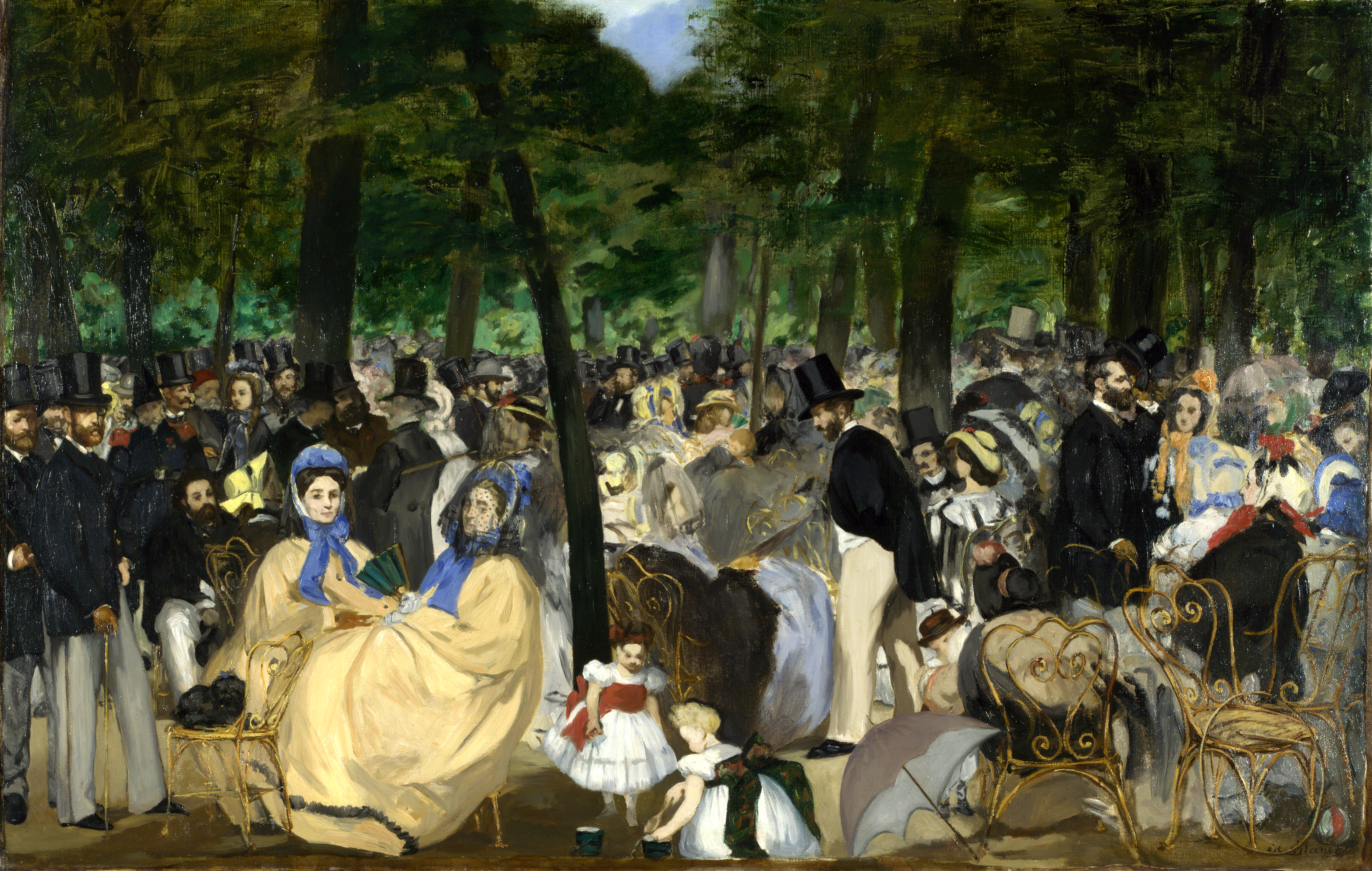
Music in the Tuileries

This painting by Manet shows the day to day life of relatively ordinary people, something highly unusual for the time. However,the techniques used in the painting were also out of the ordinary. The trees are painted in an odd way that makes them all blend together but strangest of all is the 'explosion' in the centre of the painting. This shows that Manet was already beginning to experiment with new forms of painting. This 'explosion' is not a depiction of subject matter but something odd which Manet chose to add in himself.

File:Edouard Manet - Olympia - Google Art Project 3.jpg
                                                    Olympia

This painting is viewed as the beginning of modernism because of it's flatness. Art used to be a window into another world however instead of looking 'through' this window, the flatness forces you to look 'at' it. There are some highly detailed, skillfully painted areas in the painting such as the serving girl's face or the patterned blanket. However, the nude's hair blends with the background and the cat in the corner is very badly painted. This was deliberately done, not because of a lack of skill but because the artist wished to draw attention to the canvas itself.

The painting is also making a social commentary. The model in question was a prostitute and her direct gaze casts the viewer as one of her clients. This scandalised conservatives in Paris, despite the fact that prostitutes were an accepted but hidden part of life in the city. The model's challenging stare is a protest against this hyprocrisy.

This was the beginning of Impressionism, a modern movement that believed that art should reflect the progress in the world around, therefore it was constantly changing. According to Greenberg, the "logical conclusion" of the line of painting begun by Manet was Jackson Pollock's Full Fathom 5, as it was totally flat, with no actual subject.

In the '60s, artists became tired of the dogmatic insistence that modernism should constantly change and began experiment in a more playful fashion, beginning the post-modernist movement.


Monday, 16 September 2013

First Day of Second Year

I can't believe I was excited about going back to college. Getting organised and choosing modules is horrible. I'm pretty sure that I know which modules I'll be doing though and I plan to post my notes here, so that other people can read them if they want and so that I can keep my notes in order. Hopefully, this ought to make revision easier.

My modules:
FR2101 - oral/written
FR2602 - probably
FR2404
FR2204
FR2202

GE2102
GE2113
GE2126
GE2106
GE2101- oral/discussion + essay writing/translation

So far I've had one actual lecture, that was Modernity and Modernism by Paul Hegarty. I'm planning on typing that up tomorrow. I've no idea if I'll actually stick to this plan, but I really hope I do 'cause it could be really helpful.

Anyhoo, it's been real. Til tomorrow, fair reader.