This is a rough summary and not a direct translation.
Baudelaire is amused by the ridiculous titles and comical subjects chosen by some artists. They attempt to shock people by methods of astonishment unconcerned with the art in questions. These people are not natural painters, although sometimes even talented people dishonour their skills by using these shock tactics. People spend so little time actually painting that they try to disguise and conceal their art like an unpleasant medicine in sugar capsules.
He takes the example of the title of a painting which he has not seen, Amour et Gibelotte (Love and Meat Stew). There is no obscure metaphor involved but rather an imitation of another famous title (Misanthropie et Repentir). The real title should be "Lovers Eat Meat Stew". He wonders about the appearance of these lovers and concludes it would be necessary to see the painting to find out.
The next title is "Monarchical, Catholic and Soldier." He suggests that the painting must be of someone trying to be these three things at once. But why stray from that? The artist should just say that it's an irritating method of attempting to surprise the viewer. The worst thing, he says, is that the paintings could actually be good. He remembers a nice set of sculptures he once saw but when he found out the title was "Always and Never," he was disgusted to see someone so clearly talented practising pointless word play.
He asks if the 'spiritual taste' and 'animal taste', which are the same thing, and the convoluted overwrought ideas that go with them have always existed, if great art has always been afflicted by terrible titles. He thinks it has not and that this is a purely French characteristic. The artists of France are ruining its people's taste and the artists themselves are then developing poor taste.
The focus on Truth (which is a good thing when limited to its proper uses) destroys the focus on Beauty. The public only looks for the Truth when in a particular piece of art, one should see nothing but beauty. They judge analytically rather than simply feeling.
The desire to surprise people and be surprised is perfectly natural. It is a happiness to wonder but also a happiness to dream, he says. However, one should be careful of the methods one uses to surprise. Beauty is always shocking, but that which shocks is not necessarily beautiful. Yet the public is incapable of feeling the pleasure of dreaming or admiring and instead want to be shocked by art, therefore artists conform to their tastes. Artists try to shock their audiences by undignified, unworthy methods because they know the public is incapable of being sent into raptures by true art.
Speaking of photography, he says it contributing to this nonsense which is removing all traces of the divine from the French spirit. He claims that the current creed of people the world over is that they believe in nature and nothing but nature and that art is and maybe nothing but a the exact reproduction of nature. Therefore an industry which provides them with an identical result to nature would be absolute art. By this logic, art is photography because it guarantees exactness.
He is disgusted by people who get their own photos taken, sometimes flattering themselves by having photos taken while reenacting scenes from ancient history. People treat these photographs as some kind of very great art, which he feels detracts from the true arts of painting and acting. He also objects to the use of photography for distributing obscene images.
Baudelaire views the photographic industry as the refuge of failed artists. He says their passion for it not only has the a tone of stupidity but also of vengeance. He is convinced that a conspiracy that 'stupid' cannot succeed but he also believes that the development of photography has contributed to the impovrishment of the artistic spirit of France.
Poetry and progress are two ambitions that are instinctively opposed to each other and if they encounter each other, one is obliged to be subservient to the other. If photography is allowed to take over some of arts functions, soon it will take over them all and supplant art totally, because of the natural 'alliance' between photography and the foolish masses. It is necessary therefore that photography returns to its natural position of serving art and science. He notes that photography can be extremely useful to anyone who needs exactness in their job and it has many scientific applications, however, it should not be allowed in anyway to impinge on the world of the imaginary.
Some may think that this problem could only apply to idiots, that no artist or good amateur could confuse art and industry. He says he would ask these people if they believe in the power of good or bad to be contagious or the involuntary, forced obediance of an individual to the masses. It is undeniable that the artist affects the public and that the public in turn affects the artist. The disaster is the following: as art loses respect for itself and bows to the external reality, the painter becomes more inclined to paint what he sees and not what he dreams of.
Baudelaire thinks that because of photography, people will become accostumed to viewing the results of a material science as products of beauty and that will lead to their ability to judge and feel that which is more ethereal and immaterial becoming impaired.
Showing posts with label art. Show all posts
Showing posts with label art. Show all posts
Thursday, 19 September 2013

Tuesday, 17 September 2013
FR2602 - L1 - Modernism and Modernity
In art, the term 'modern' refers to a period in art history defined by specific characteristics. It is hard to tie this term down to specific dates, however, it is not used to refer to art made now or today or last year. That is known as contemporary art.
The term 'modernity' refers to the period of time. The term 'modernism' refers to the artistic response to this time, however, the response can affect the culture of period.
Modernism is said to have begun in 1863 but modernity is harder to date. The period can be defined by certain characteristics:
Society became more open to change as the onset of capitalism created a richer middle class. In the 1840s, artists began to show ordinary life for the first time which was extremely radical at the time.
Éduoard Manet:
This painting by Manet shows the day to day life of relatively ordinary people, something highly unusual for the time. However,the techniques used in the painting were also out of the ordinary. The trees are painted in an odd way that makes them all blend together but strangest of all is the 'explosion' in the centre of the painting. This shows that Manet was already beginning to experiment with new forms of painting. This 'explosion' is not a depiction of subject matter but something odd which Manet chose to add in himself.

Olympia
This painting is viewed as the beginning of modernism because of it's flatness. Art used to be a window into another world however instead of looking 'through' this window, the flatness forces you to look 'at' it. There are some highly detailed, skillfully painted areas in the painting such as the serving girl's face or the patterned blanket. However, the nude's hair blends with the background and the cat in the corner is very badly painted. This was deliberately done, not because of a lack of skill but because the artist wished to draw attention to the canvas itself.
The painting is also making a social commentary. The model in question was a prostitute and her direct gaze casts the viewer as one of her clients. This scandalised conservatives in Paris, despite the fact that prostitutes were an accepted but hidden part of life in the city. The model's challenging stare is a protest against this hyprocrisy.
This was the beginning of Impressionism, a modern movement that believed that art should reflect the progress in the world around, therefore it was constantly changing. According to Greenberg, the "logical conclusion" of the line of painting begun by Manet was Jackson Pollock's Full Fathom 5, as it was totally flat, with no actual subject.
In the '60s, artists became tired of the dogmatic insistence that modernism should constantly change and began experiment in a more playful fashion, beginning the post-modernist movement.
The term 'modernity' refers to the period of time. The term 'modernism' refers to the artistic response to this time, however, the response can affect the culture of period.
Modernism is said to have begun in 1863 but modernity is harder to date. The period can be defined by certain characteristics:
- progress
- secularism
- science
- democracy
- industry
- capitalism
Society became more open to change as the onset of capitalism created a richer middle class. In the 1840s, artists began to show ordinary life for the first time which was extremely radical at the time.
Éduoard Manet:
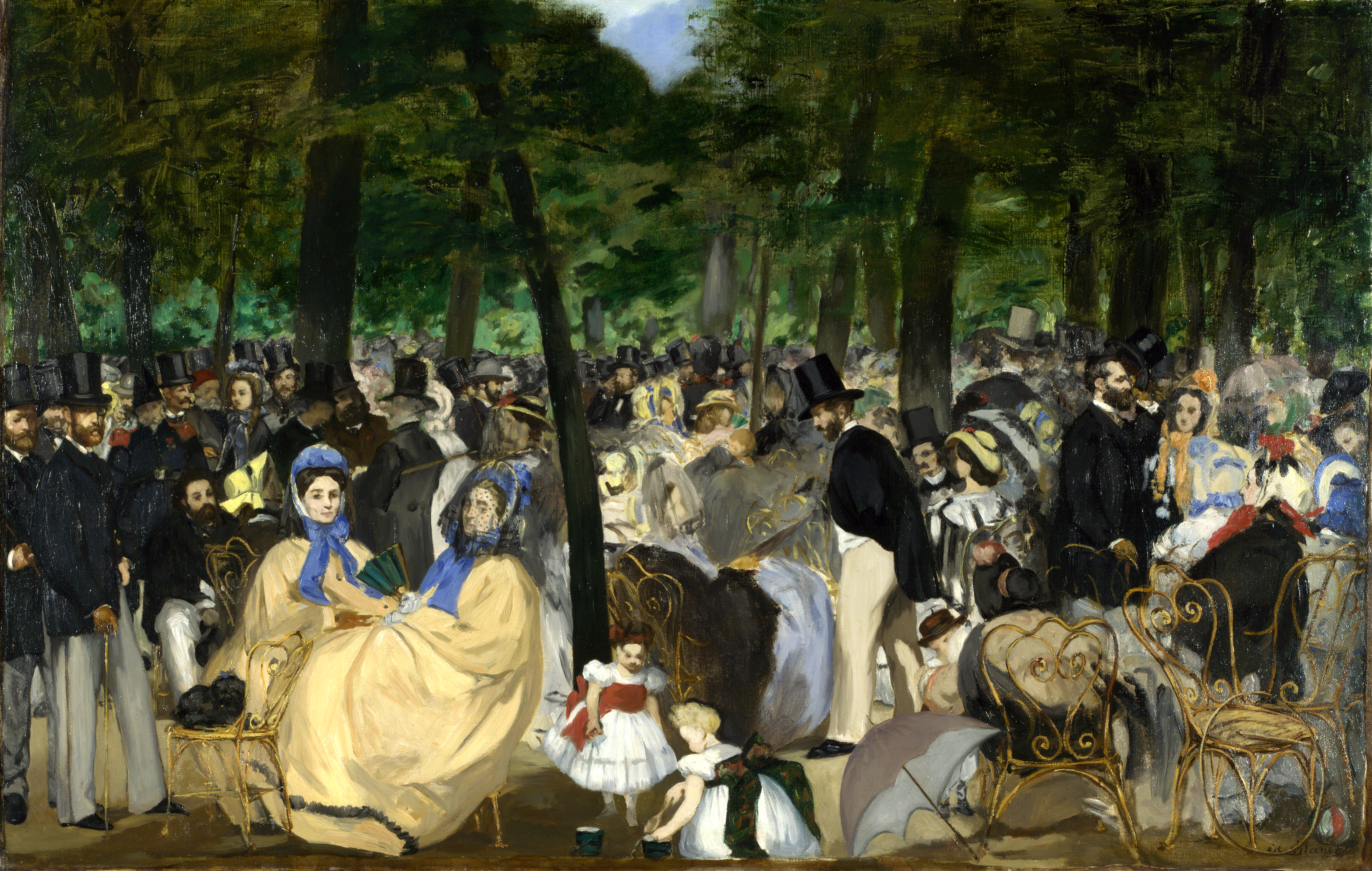 |
| Music in the Tuileries |
This painting by Manet shows the day to day life of relatively ordinary people, something highly unusual for the time. However,the techniques used in the painting were also out of the ordinary. The trees are painted in an odd way that makes them all blend together but strangest of all is the 'explosion' in the centre of the painting. This shows that Manet was already beginning to experiment with new forms of painting. This 'explosion' is not a depiction of subject matter but something odd which Manet chose to add in himself.

Olympia
This painting is viewed as the beginning of modernism because of it's flatness. Art used to be a window into another world however instead of looking 'through' this window, the flatness forces you to look 'at' it. There are some highly detailed, skillfully painted areas in the painting such as the serving girl's face or the patterned blanket. However, the nude's hair blends with the background and the cat in the corner is very badly painted. This was deliberately done, not because of a lack of skill but because the artist wished to draw attention to the canvas itself.
The painting is also making a social commentary. The model in question was a prostitute and her direct gaze casts the viewer as one of her clients. This scandalised conservatives in Paris, despite the fact that prostitutes were an accepted but hidden part of life in the city. The model's challenging stare is a protest against this hyprocrisy.
This was the beginning of Impressionism, a modern movement that believed that art should reflect the progress in the world around, therefore it was constantly changing. According to Greenberg, the "logical conclusion" of the line of painting begun by Manet was Jackson Pollock's Full Fathom 5, as it was totally flat, with no actual subject.
In the '60s, artists became tired of the dogmatic insistence that modernism should constantly change and began experiment in a more playful fashion, beginning the post-modernist movement.
Subscribe to:
Posts (Atom)